



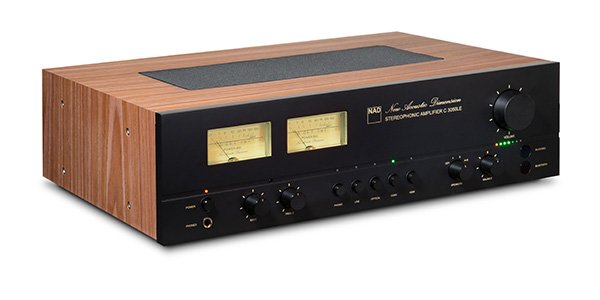
NAD was little identified in 1980, however the 3020 put the model on the map, the corporate promoting 1.1 million items over the amplifier’s lifetime. NAD subsequently went by possession adjustments and in 1999 was bought by Canada’s Lenbrook Group, the model’s Canadian distributor since 1978.
Stereophile has favorably reviewed many NAD amplifiers over the many years. One of the vital current was the Grasp Collection M10 class-D streaming built-in amplifier, which I bought to make use of as my each day driver after I reviewed it in January 2020. The M10’s worth included a free license for Dirac Stay low-frequency room equalization, which I discovered invaluable with my long-term reference standmounts, the KEF LS50s. So after I realized that NAD was introducing a fiftieth Anniversary built-in amplifier, the C 3050 LE, which additionally included Dirac Stay, I requested for a evaluate pattern.
The C 3050 LE (Anniversary Version)
The LE within the amplifier’s identify stands for Restricted Versionsimply 1972 samples shall be offered at a US worth of, you guessed it, $1972. (1972 was, as talked about above, the 12 months of the corporate’s founding.) The worth consists of an MDC2 BluOS module. (There shall be a non-LE model, which is able to price $1899 with the BluOS module, $1299 with out it.)
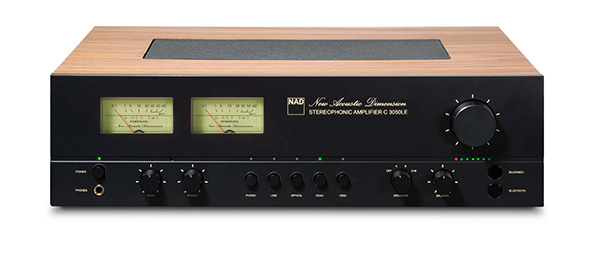
With its wood-grain vinyl wrap, the cursive-font “New Acoustic Dimension” emblem on the entrance panel, and its twin, illuminated VU meters, the amplifier’s styling is distinctly retro, resembling that of the NAD 3030 amplifier from 1976. Inside, nevertheless, the C 3050 LE is totally fashionable. The BluOS module permits audio to be streamed from native storage on the proprietor’s community or from Tidal, Qobuz, Amazon Music Extremely HD, Deezer, TuneIn radio stations, and different streaming companies,with digital decision as much as 24bits and a pattern price of 192kHz. MQA unfolding is supported. Audio could be streamed from iOS gadgets with Apple AirPlay 2, and the BluOS module works with the Spotify Join and Tidal Join apps. Music may also be streamed from cell gadgets to the amplifier or from the amplifier to wi-fi headphones with two-way Bluetooth aptX HD. Playback could be voice-controlled utilizing Amazon Alexa, Google Assistant, or Apple’s Siri. An IR distant management is supplied, and multiroom operation and integration with good home-control techniques is supported.
BluOS is an app-based multiroom “music ecosystem” (suppose Roon) which gives entry to your individual content material and integrates numerous music companiesnot simply the standard suspects like Tidal and Qobuz but in addition some obscure ones, resembling nugs.internet, IDAGIO, and Bugs, which is out there solely in South Korea. If a streaming service is not out there, you possibly can ship it to the C 3050 LE with BlueTooth or AirPlay.
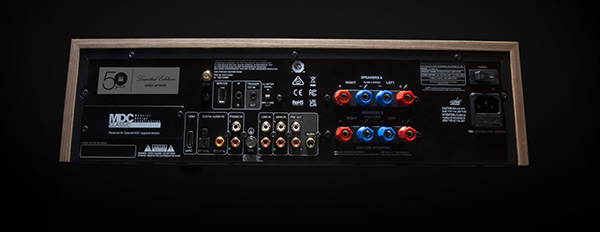
The C 3050 LE accepts information through HDMI eARC, Kind A USB, and coaxial and optical S/PDIF inputs. The C 3050 LE’s D/A circuit makes use of Texas Devices PCM5242 differential-output DAC chips. These can decode PCM information as much as 32 bits and 384kHz, although the amplifier’s playback is restricted to 192kHz. Put in on the decrease left of the again panel is the MDC streaming module (however non-compulsory on the forthcoming non-LE model) with an Ethernet port, mounts for the included Bluetooth and Wi-Fi antennas, a service port, and a USB-A enter to attach a reminiscence stick or “supported peripherals.” The Gigabit RJ45 (Ethernet) enter helps sampling charges as much as 192kHz and bit depth as much as 24. Analog inputs embody one pair of line-input RCA jacks and one pair of RCA jacks for MM phono enter; all are digitized by the C 3050 LE, and RIAA correction is carried out digitally. Jumpers join a pair of single-ended preamp output jacks to single-ended amplifier enter jacks. The supplied subwoofer output could be adjusted with the BluOS app, and there is a ¼” headphone jack on the entrance panel.
Entrance-panel controls enable the person to regulate treble and bassthese could be bypassed with the BluOS appin addition to steadiness and quantity. A rotary change selects both or each loudspeaker outputs, turning them off for headphone listening. The C 3050 LE’s energy amplifier stage makes use of HybridDigital UcD class-D modules and the utmost steady energy is specified as 100Wpc into 8 or 4 ohms; instantaneous most energy is specified as 180W into 8 ohms, 250W into 4 ohms, and 300W into 2 ohms.
Setup
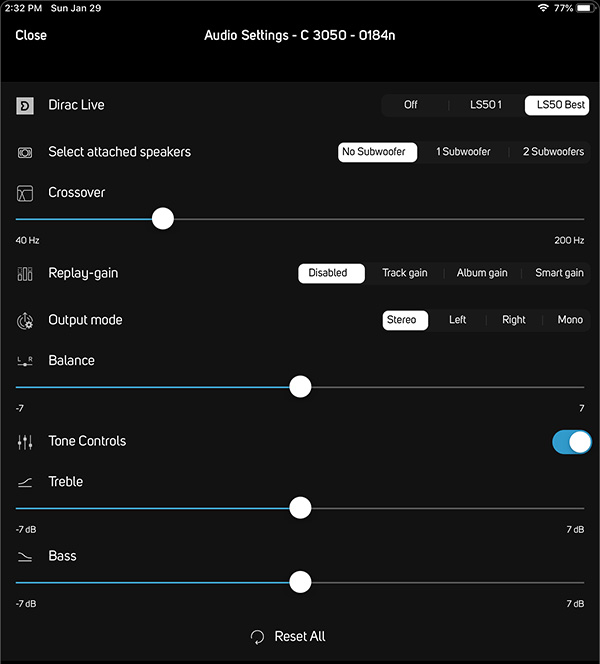
Set up of the C 3050 LE was easy. I related its Ethernet port to my community and arrange its Wi-Fi connection. I put in the BluOS app (v.3.20.2) on my iPad mini 2 (above) and used this to examine that the amplifier’s firmware was updated. I then logged into my Qobuz and Tidal accounts. The BluOS app situated and listed the audio library I take advantage of with my Roon Nucleus+. (Although the Roon app acknowledged the NAD, it reported that “the producer has not but accomplished certification for this machine.”) I related the single-ended analog outputs of my Ayre Acoustics C-5xeMP disc participant to the NAD’s line inputs with Canare interconnects, the participant’s AES3 output to the TosLink enter through a Z-Techniques RDP-1 used as a format converter. The NAD’s speaker outputs have been related to my KEF LS50s with AudioQuest Robin Hood cables.
A rear-panel change selects whether or not the C 3050 LE’s front-panel meters present the enter or the output sign ranges, set with a back-panel change. I caught with the previous. The amplifier’s quantity setting is indicated with a row of LEDs on the fitting of the entrance panel. The leftmost LED is orange, and inexperienced LEDs successively mild as much as its proper as the amount is elevated. A button on the distant management permits these LEDs to be dimmed, however even on the lowest setting, they’re nonetheless shiny. Thankfully, they are often turned off utterly. The VU meters stay illuminated.

NAD says that the MDC2’s two-way communications enable Dirac Stay to work with all sources related to the C 3050 LE. To make use of Dirac Stay with the amplifier, I plugged the included microphone into the three.5mm jack on the also-included USB adapter then plugged that into the C 3050 LE’s USB Kind A port. I put in the Dirac Stay app (above) on my Mac mini, after first ensuring that it and the C 3050 LE have been related to the identical Wi-Fi community. The app discovered and recognized the amplifier as “C 3050 0184n.” I then adopted the on-screen directions for “tightly centered imaging,” inserting the microphone in every of the 9 positions specified by the app and performing a “chirp” check at every. Dirac then calculated a correction filter working under 500Hz (under) and requested first for it to be named, then to be saved to one of many 5 slots within the C 3050 LE’s DSP reminiscence. Once I ran the BluOS app on the iPad, the Audio Settings menu now included an on/off change for the Dirac filter. With Dirac energetic, there was a 10dB discount in stage, presumably to maintain the equalized digital sign from exceeding 0dBFS.

Responses of the low-frequency correction filters calculated by Dirac Stay for the KEF LS50s in JA’s room. (Left channel blue, proper crimson.)
Footnote 1: Edvardsen handed away in 2018.
Footnote 2: Additionally see en.wikipedia.org/wiki/NAD_3020.
