



Nothing labored because it ought to. The stalk for the blinkers was lacking; I substituted a screwdriver. The radio was like a wavering zombie: lifeless in the future, sputtering to life the following. I received properly acquainted with jumper cables. At some point, I opened the trunk and located tiny mushrooms sprouting from the carpet.
On the plus facet, I by no means acquired a dashing ticket: The engine smoked if you happen to drove sooner than 45mph, so I did not.
Years later, once I received into hi-fi, I considered that automotive and subsequent ones. What stood out to me most about high-end audio was: separates. Moderately than gravitate towards worthy one-box options, audiophiles appeared obsessive about splitting issues aside. They needed to have a standalone energy amp, preamp, sources, audio system, cables. “What if you happen to purchased a automotive that means?” I assumed to myself. A suspension from one producer, a chassis from one other, wheels from a 3rdand sure, a used blue hood from a junkyard. Appears fairly psychological. No thanks.
It is not a exact analogy, I understand. When it’s important to get from level A to level B, you purchase a one-box automotive resolution. Bolting collectively mismatched automotive elements would not work in any respect. Audio, however, is kind of standardized. Most parts are simply linked, and so they work collectively moderately properly. Nonetheless, even if you happen to forgo Nineteen Fifties all-in-one consoles (footnote 1), ’70s receivers, and (ugh) ’80s boomboxes, why cannot the will for excellent sound be sated with a single-box repair, similar to transportation? Simply please give me one thing that works higher than my French jalopy did.
Every little thing you want (virtually)
For roughly half a decade, we have seen a spate of merchandise that do exactly that. The Naim Uniti Atom is a superb instance; so are the T+A Cala and NAD’s Masters Collection M10 and M33. Every little thing you want in a single fieldsimply add audio system (footnote 2).
Korea’s HiFi Rose not too long ago joined the fray with the RS520. Conceptually, it is the love youngster of HiFi Rose’s RA180 GaN FET class-D built-in amplifier ($6995; footnote 3) and the RS250A community streamer ($2695). Combining a well-thought-out streaming system, DAC, preamp, and amplifier, the unit is as versatile and full-featured as you might want. Okay, not fairly: The RS520 has no silver-disc transport, no headphone output, no subwoofer outputs, no balanced ins or outs, no phono stage. With these caveats out of the way in which, let’s check out the laundry record of applied sciences and options that RS520 consumers do get.
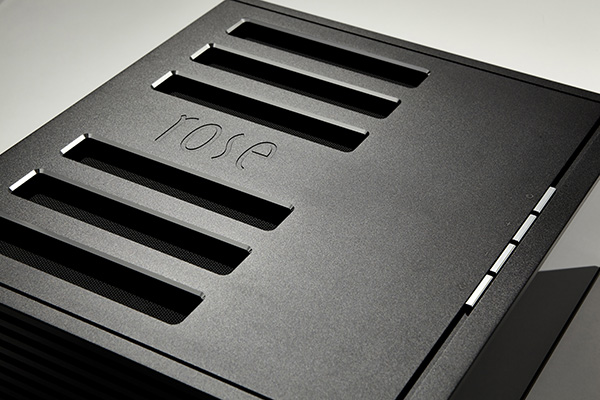
Milled from a block of aluminum, the RS520’s casework (in silver or black) is elegant and understated. Each the left and proper flanks have 11 shallow ridges that enhance warmth dissipation. On high, to every facet of the phrase “Rose” engraved within the middle, is a cluster of three silver-rimmed vents that additional assist with cooling. Additionally on the highest, close to the entrance edge, are 4 slender silver buttons, every about an inch lengthy. From the left, the primary three are Mute/Unmute, Quantity Down, and Quantity Up. The fourth management is an influence button that, with an extended press, helps you to flip off simply the display whereas maintaining the element totally lively.
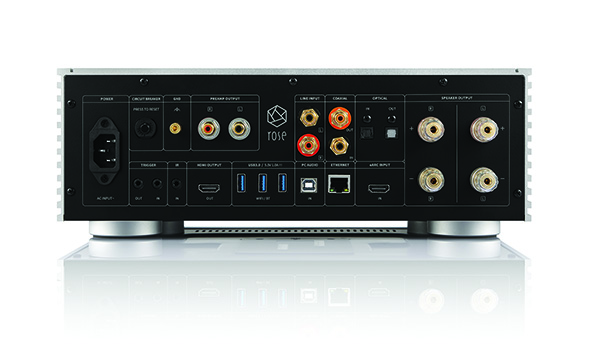
Situated on the proper of the rear panel, the binding posts are spaced far sufficient aside to accommodate massive spades. Transferring to the left, we see TosLink and RCA S/PDIF ports (inputs and outputs), an eARC enter, an RJ45 connection, a USB-B enter, an analog-input RCA stereo pair, and three USB 3.0 A-style inputs. (The center one is reserved for the included Wi-Fi/Bluetooth antenna; the opposite two can be utilized to connect storage.) Rounding out the connections are an HDMI output, RCAs for the preamp out, the same old set off and infrared management ports, a floor terminal, and a 15A IEC socket.
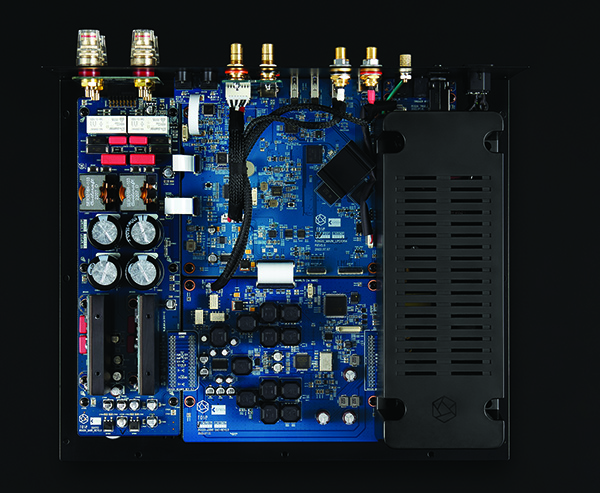
Inside, HiFi Rose says, the analog and digital circuits are mounted on separate boards to forestall digital noise from affecting analog indicators.
The underside of a stereo element hardly ever warrants consideration, however right here there’s an empty bay on the underside for a 2.5″ strong state drive (not included).
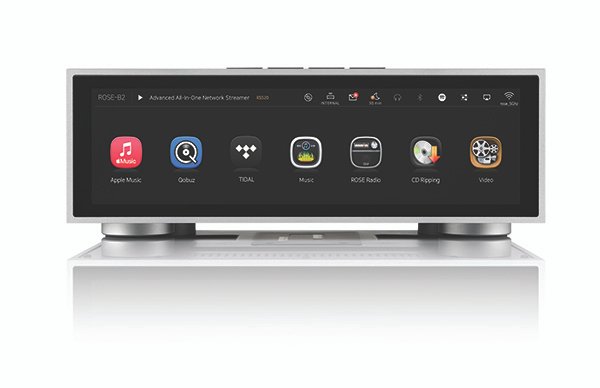
I’ve saved the perfect for final. The fascia is fully taken up by the largest show I’ve ever seen on a stereo elementaside, that’s, from HiFi Rose’s personal RS150B streamer ($4995), which is even wider than the one on the RS520. After you subtract the 0.6″ bezel, the 520’s display measures a whopping 12.25″ × 3.5″. The display is the element’s foremost attraction by way of shelf attraction.
The competitors has taken discover. At a latest audio present, the rep for a number one model of streamers instructed me that he regards the RS520 as a “large disruptor” as a consequence of its aggressive worth and expansive display. All of the sudden, different streamers’ shows appear puny by comparability.
As associates dropped by to see my newly constructed listening room and hang around and play some favourite recordings, each single one commented on the HiFi Rose. They approached, swiped, tapped, grinned. And why not? I imply, you may set the jumbo LED show to imitate a Nixie clock (footnote 4) or the fascia of a full-size FM tuner. When streaming audio, a few faucets on the display produce digital VU metersyour selection of designs and colours (footnote 5). Maybe it is a bit of foolish, nevertheless it’s completely charming. I’ve admired many audio merchandise that handed by means of my dwelling, however I do not assume I’ve ever had as a lot enjoyable with one (footnote 6). “That factor is cool!” was my guests’ shared verdict.
I did encounter one naysayer, although not in my dwelling. “Who wants an iPad stapled to their amp?”, a gentleman on a web based audio discussion board bristled. It was identified to the sourpuss that the RS520’s display will be turned off, as I usually did; I like listening at nighttime.
Jon Derda of MoFi, HiFi Rose’s distributor, believes the 2 corporations have a winner on their palms. “Along with sound high quality, there are two differentiators that leap out” in regards to the RS520, he wrote in an e-mail. “The primary is the entrance panel. With the ability to learn the title of the track from throughout the room is a sensible profit that parts with small screens cannot present.”
No kidding. The RS520 is the primary audio element with a display that lets me simply learn the track title and artist’s title from my listening place, 1314′ from my gear. Only a fast look; no squinting.
The second large distinction, Derda says, is the ability of the amplifier: a specified 250Wpc into 8 ohms or 4 ohms. “Many parts within the all-in-one class ship 50 to 100 watts per channel. The amp within the RS520 can drive a a lot wider vary of loudspeakers than the opposite one-box options.”
He is not flawed, though I am going to observe that the $5999 NAD M33, which I reviewed for a special publication, comes shut; it is specified to provide 200W of Purifi Eigentakt energy per channel with an 8 ohm load. The NAD drove the a number of pairs of audio system I threw at it with exemplary punch and readability. However positive: My Naim Uniti Atom streamer amplifier, which I really like for its lovely design and pristine sound, has a more durable time with some less-sensitive audio system as a consequence of its a lot decrease energy output, specified as 40Wpc into 8 ohms. The T+A Cala, at 50Wpc (footnote 7) , is on the modest facet as properly.
Channeling a Swiss Military knife
The RS520 is Roon Prepared and might deal with each digital format I am aware of (AAC, AIFF, ALAC, FLAC, MP3, MQA, OGG, WAV, WMA) plus some I might by no means even heard of. It helps playback of PCM sources as much as 32/768 and DSD sources as much as DSD512. The DAC is constructed across the glorious ES9038PRO Sabre chip, which claims 122dB THD+N and a dynamic vary of 140dB. It is the identical digital-to-analog tech you may discover within the RS150B, the corporate’s flagship streamer.
Energy comes from a GaN FET amplifier part that runs in class-Dthough the Korean crew, with a nod to the analog-ish sonics of the RS520, likes to discuss with it as “Class-AD.” GaN stands for gallium nitride. In semiconductors, the fabric has some main benefits over silicon, as JMu defined in her Stereophile assessment of HiFi Rose’s RA180 amplifier: “GaN FETs reply sooner to transients, dynamic swings, and so forth., with much less overshoot and shorter restoration time. The result’s sooner switching occasions (with much less ‘lifeless time’) and extra exact switching with much less ringing, distortion, and EMI (electromagnetic interference). Class-D designs use adverse suggestions to offset such distortion; silicon-based amps want various it to carry out at their finest. Beginning with extra exact, sooner amplification signifies that much less suggestions is required.” Sonically, it ought to all add as much as “much less harshness and extra smoothness, improved element, and a extra impartial presentation.”
After you press the 520’s energy button and wait about 25s for bootup to finish, you are greeted with a row of icons that provide you with entry to your music. The 520 presents AirPlay 2, Spotify Join, Tidal, Qobuz, Apple Music, and far more. Swipe left or proper on the entrance panel, and you will find icons that unlock Rose-specific content material. RoseHome reveals tracks that the algorithm thinks you may like, plus a listing of recordings you latterly performed. RoseRadio helps you to entry web music stations world wide. RoseFM transforms the RS520’s entrance panel right into a near-photorealistic rendition of a Seventies-style tuner, full with a ribbed horizontal frequency dial that is fully useful (however with out the tactile suggestions, natch).
RoseTube is a music-oriented, ad-free YouTube portal. That is proper: You may play video on the 520’s display. Then once more, why would you need to? Higher to route the HDMI output to a big- display, hi-def TV, ought to your listening room have one.
Footnote 1: See tinyurl.com/ybkdzs7r.
Footnote 2: Or not: I just like the Sonus Faber Omnia and love the Naim Mu-so; each have audio system inbuilt.
Footnote 3: Though the 2 parts look nothing in any respect alike.
Footnote 4: See en.wikipedia.org/wiki/Nixie_tube.
Footnote 5: These colours now not embrace “McIntosh blue,” one of many 520’s unique VU meter presets. It appears that evidently some of us in Binghamton objected.
Footnote 6: Till I learn Rogier’s description throughout enhancing, I might considered this designof the RS520 and the 2 streamers within the HiFi Rose lineupas relatively boring. Now I do know I used to be flawed. Considering additionally of the very completely different however extraordinary-looking RS180, it turns into clear that hi-firack wow issue is a giant a part of the HiFi Rose strategy.Jim Austin
Footnote 7: T+A specs say 2 × 100W, however that is right into a 4 ohm load. Apples to apples.
