



Newswise — Within the pitch darkish of the cosmos lurks an invisible form of matter. Its presence is seen within the rippling ebb and circulate of galaxies, but it surely’s by no means been straight noticed. What secrets and techniques lie beneath the floor, brewing within the deep?
Physicists have lengthy theorized concerning the composition of darkish matter, which is regarded as 5 instances extra plentiful than common matter. Amongst competing hypotheses, one particle has emerged as a promising candidate: the axion.
Researchers at Aalto College are setting out on a six-year undertaking to seek out proof for the existence of axions. They may accomplish that as a part of a newly based consortium known as DarkQuantum, alongside researchers on the College of Zaragoza, who’re coordinating the undertaking, in addition to researchers on the French Nationwide Centre for Scientific Analysis, Karlsruhe Institute of Know-how, and different associate establishments.
This new consortium would be the first to make use of the newest quantum applied sciences to construct sensors with unprecedented scanning sensitivity. DarkQuantum was awarded €12.9 million on October 26 by the European Analysis Council, of which roughly €2 million is put aside for Aalto College Senior Lecturer and Docent Sorin Paraoanu and his Superconducting Qubits and Circuit QED (KVANTTI) analysis group.
‘We’re peering right into a deep, darkish pit. If it exists, the axion goes past the usual mannequin of elementary particles,’ Paraoanu says. ‘Such an commentary could be comparable in significance to the Higgs boson discovery within the early 2010s. However at the very least with the Higgs boson, they knew the place to begin wanting!’
‘The character of darkish matter is among the largest mysteries in trendy science,’ provides College of Zaragoza Professor Igor Garcia Irastorzawho additionally heads the DarkQuantum consortium. ‘If darkish matter is manufactured from axions, now we have an actual probability of detecting it with this undertaking.’
Though there have been makes an attempt to watch axions up to now, this newest endeavor will capitalize on quantum phenomena to allow researchers to higher filter out noise and repeat their experiments with larger constancy. That’s the place Paraoanu and his staff are available in.
Transferring mountains
Zoom into our small nook of the Milky Method galaxy, deep below the mountains spanning the border between Spain and France. That is the positioning of the Canfranc Underground Laboratory, which can home a high-frequency sensor the DarkQuantum researchers plan to construct. The opposite, low-frequency sensor can be positioned on the German Electron Synchrotron (DESY) in Hamburg.
Paraoanu and his KVANTTI group are primarily chargeable for constructing and tuning the high-frequency sensor, in addition to writing the algorithms and software program to make use of it. This sensor, known as a haloscope, will probe the depths of the galactic halo in the hunt for axions.
Placing the sensor deep underground helps get rid of cosmic background radiation, and it might supply a singular alternative to concurrently examine sure noise-reduction strategies for quantum computing.
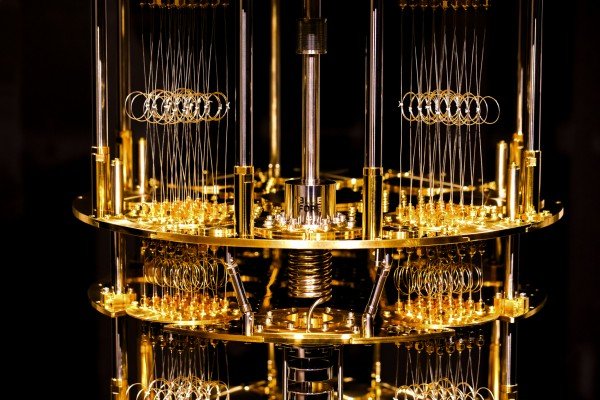
‘Our high-frequency sensor can be 10-100 instances extra delicate than earlier iterations, and it is going to be capable of scan on the dimensions of some microelectron volts. It should use superconducting qubits—the identical qubits utilized in quantum computer systems—however they’ll serve in a special function as detectors on this haloscope,’ Paraoanu says.
Earlier makes an attempt to detect axions have used linear amplifiers, which are inclined to introduce noise and successfully soak up particles into the system. Paraoanu’s sensor will depend on quantum nondemolition measurements, which can enable for repeated experiments with the identical particles.
‘The speculation means that, in an ultra-cold surroundings, we will introduce a magnetic subject that may trigger any axions current to decay into photons. If we detect any photons within the cavity, then we will conclude that axions are current within the system, and that they do certainly exist,’ Paraoanu says.
Synergy Grant
The European Analysis Council’s Synergy Grant is prestigious, and Paraoanu and his staff are solely the second in Aalto College’s historical past to obtain the grant—the primary was awarded to Professor Risto Ilmoniemi for his ongoing ConnectToBrain undertaking.
The six-year undertaking can be damaged into two components: a four-year scaling up part, which incorporates the development, tuning and transportation of the haloscopes; and a two-year experimental part, by which the staff will collect information. Paraoanu expects to have openings for a number of researcher positions within the undertaking within the coming years.
Different associate establishments named within the Synergy Grant embody the Max Planck Society for the Development of the Sciences, the Polytechnic College of Cartagena, and the Spanish Nationwide Analysis Council.
Paraoanu and the KVANTTI analysis group will perform their work utilizing OtaNano gear. OtaNano is Finland’s nationwide analysis infrastructure for micro-, nano-, and quantum applied sciences. Particularly, Paraoanu will carry out his work on the Low Temperature Laboratory, based by Finnish physicist Olli V. Lounasmaa. Paraoanu can be concerned in InstituteQ and within the new Finnish Quantum Flagship (FQF).
