



The Science
Newswise — Understanding how vitality strikes in supplies is prime to the examine of quantum phenomena, catalytic reactions, and complicated proteins. Measuring how vitality strikes includes shining particular X-ray mild onto a pattern to begin a response. Detectors then accumulate the radiation the response emits. Typical sensors normally lack the sensitivity wanted for these research. One answer is to make use of superconducting sensors. However amplifying the indicators from these sensors is a serious problem. Constructing on advances from quantum computing, researchers added a particular sort of amplifiers, superconducting traveling-wave parametric amplifiers. Whereas most amplifiers add noise to the measurement, these amplifiers are nearly noiseless. In a serious advance, researchers just lately confirmed that the amplifiers can function at 4 Kelvin, which is taken into account comparatively excessive working temperatures.
The Affect
Decreasing the noise that’s added throughout sign processing can enhance a sensor’s efficiency. Amplification permits every sensor to function quicker and be extra delicate. Latest experiments have proven that parametric amplifiers can probably analyze indicators from many superconducting sensors on the similar time. Superconducting sensors work at very low temperatures. At these temperatures, parametric amplifiers have excellent noise efficiency, near the restrict of quantum mechanics. The advance paves the best way to combine such amplifiers with a wide range of sensor applied sciences.
Abstract
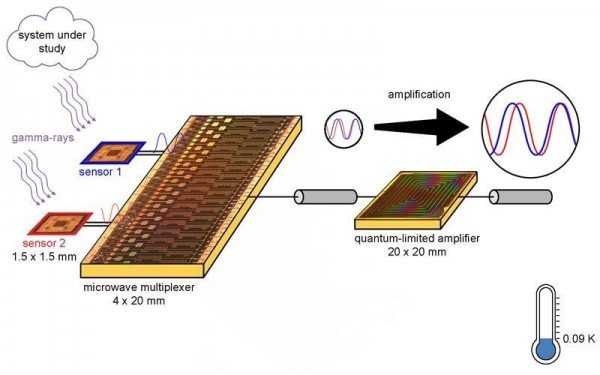
A superconducting sensor consists of a superconducting thermometer and an absorber. When X-rays are stopped within the absorber, they alter the superconducting state of the sensor. This generates a small present in {an electrical} circuit. To make the detector extra delicate, many sensors are organized into an array, like in a digital digicam. Superconducting sensors function at very chilly temperatures (roughly 0.09 Kelvin), so that they require specialised readout electronics and amplifiers. These amplifiers want to mix the indicators from a number of sensors on a single readout line. Combining indicators is named multiplexing. One environment friendly manner to do that is to couple every sensor in an array to a resonator. The entire resonators are coupled to a single output line. The present produced by an absorbed photon shifts the resonant frequency in a novel manner for every sensor.
As a result of these resonators work in microwave frequencies, the digital chip that comprises all of the resonators in addition to the output feedline is named the microwave multiplexer. Researchers are making ready to measure the indicators from an array of sensors and a microwave multiplexer with a readout chain whose first amplifier is a kinetic-inductance traveling-wave parametric amplifier as a substitute of a traditional semiconductor amplifier. Utilizing the parametric amplifier will scale back readout noise and allow bigger arrays of quicker sensors.
Funding
This work was funded by the Division of Vitality Workplace of Science, Fundamental Vitality Sciences Accelerator and Detector Analysis Program, the Nationwide Institute of Requirements and Expertise’s Improvements in Measurement Science Program, and NASA.
