



However while you have a look at a Rolls or a Bentley, you instantly acknowledge it for what it’s, and also you need to sit down in it. And so it’s with McIntosh, besides you do not need to sit down in it; you need to sit down in entrance of it, between the audio system of the hi-fi system it occupies.
Historical past issues. When a brand new mannequin from Bentley seems, there’s a connection to what got here earlier than it, a protracted custom. There isn’t any pretense of reinventing wheels; as a substitute, it is about rolling these wheels a bit farther on down the street. That heritage leads to a comforting familiarity. From the primary audio merchandise McIntosh supplied, in 1949, down to the current lineup, any educated client can have a look at it and instantly know what it is for and acknowledge its worth. Specifically, individuals worth a legacy of high quality, particularly when so many older, classic merchandise are on the market and nonetheless working. It feels good figuring out that the factor you are shopping for is more likely to final and be pleasurable and satisfying to make use of for a very long time.
The C12000 is McIntosh’s present flagship preamplifier. It is a part of McIntosh’s Hybrid Drive collection of merchandise that mix tubes and transistors in attention-grabbing methods. The primary McIntosh product to include such a mixturethough it preceded the advertising and marketing time period by a number of yearswas the MA252 stereo built-in amplifier, launched in 2017. It was “hybrid” within the acquainted sense, pairing a tubed preamplifier stage with a 100W stable state amplifier. The vary has since expanded to incorporate amplifiers, preampseven a CD/SACD participant.
Presently, McIntosh presents eight preamplifiers, however solely the C12000 is Hybrid Drive. This prime-cut, all-analog, dual-chassis mannequin, with separate containers for the ability controller unit and the signal-path circuitry, continues a line began with the stable state C100, McIntosh’s first two-chassis preamp, which was launched in 1997. The C100 was adopted eight years later by the C1000, a hybrid machine: You possibly can select both the stable state chassis (C1000P) or the tubed chassis (C1000T), or you can get each preamp chassis and the C1000C controller for $26,000. The C1000 was succeeded in 2015 by the C1100, however, although additionally a dual-chassis preamp, the C1100 was all-tube.
The C12000, which is now McIntosh’s flagship stereo preamp, returns to the C1000’s hybrid method, however now each units of electronics, tubed and stable state, occupy a single chassistwo chassis altogether together with the controller. With the C12000, the value for a flagship McIntosh dual-mode preamplifier has fallen by loads, to $16,000.
Separation of powers
The very first thing to notice in regards to the two-box C12000 (after noting that there are two containers) is that though they’re freestanding, the 2 chassis have to be joined by a pair of three’-long cables terminating in proprietary 23-conductor connectors. Three ft is not lengthy, so the 2 preamp containers want to sit down aspect by aspect or maybe vertically with appropriate separation; McIntosh says do not stack them. (In actual fact, within the proprietor’s handbook, McIntosh suggests slicing a gap within the shelf above to make sure enough air flow.)
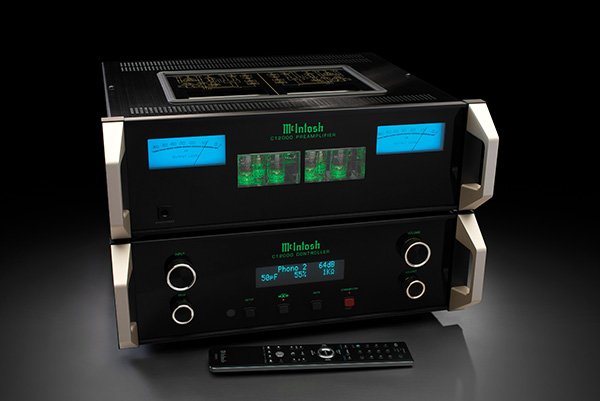
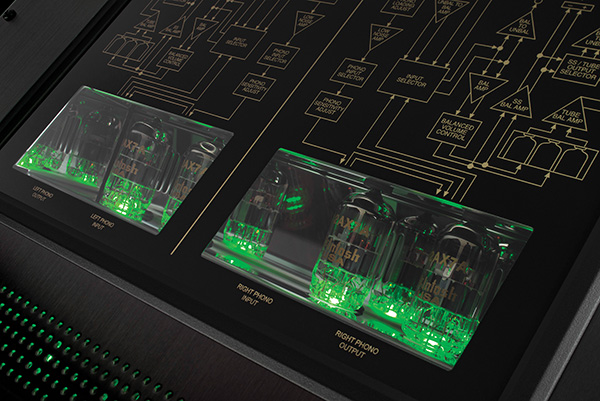
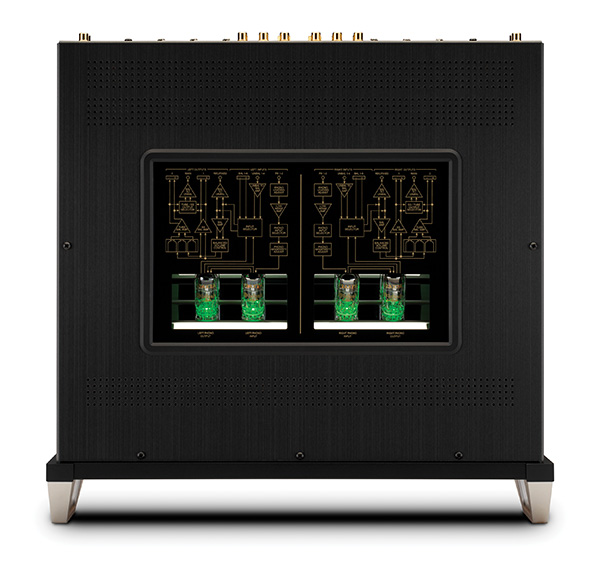
Match’n’end is excellent. Each chassis function the identical load-bearing handles discovered on different premium McIntosh fashions; the handles are each practical and aesthetic. Aesthetics are additional enhanced by the normal, backlit McIntosh logos towards black glass and, on the preamplifier module, a pair of meters that glow blue and home windows that show green-illuminated 12AX7 tubes. Captain Nemo would dig it.
I requested McIntosh whether or not this two-box method improved the preamp’s specs. Joe Guelzow, McIntosh Labs’ digital design engineer, responded: “Sure, when in comparison with different tube preamplifiers we produce at McIntosh, discount in noise might be [lower] by at the very least 4dB and even 10dB, relying on the enter. The twin-chassis design fully separates all energy provide, microprocessor, and management circuits from the pure audio circuits for complete noise isolation.” The desired S/N ratio of the high-level output is rated at a formidable 107dB (A-weighted), measured at 2.5V. If that is correct, that is an exceptionally quiet preamplifier (footnote 1).
Unusually for a two-channel preamp, the rear panels of each chassis are comparatively full. The controller’s again panel is dominated by set off inputs and outputs on 3.5mm ministereo jacks, meant to manage different connected McIntosh elements, sending remote-control indicators and turning the lights on and off. The one different connectors on the controller’s rear panel are a USB port for manufacturing facility updates and the left- and right-channel connectors for the customized, 23-pin umbilical cables that join the management module to the preamp module. An AC energy twine socket completes the image.
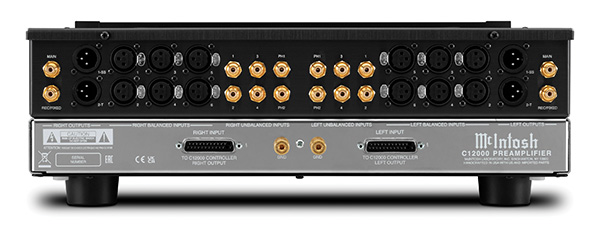
A look on the preamp module’s again panel provides an thought of what the C12000 designers had been aiming for. It is what you do not see: There are no digital inputs. There is no DAC on board, simply numerous old-school analog RCA and XLR jacks: six pairs of balanced line inputs and 4 pairs of single-ended line inputs plus two pairs of single-ended inputs for the phono stage. For outputs, there are two pairs of balanced, a pair of unbalanced labeled “Fundamental,” and one other pair of unbalanced labeled “Rec/Fastened out.” The 2 pairs of balanced outputs are labeled “1-SS” for stable state, “2-T” for tubed. To modify from stable state to tube, you turn from output 1 to output 2. The unbalanced Fundamental outputs might be set to both tube or stable state through inner settings.
This is one other factor you will not see on the C12000, even behind the scenes in setup mode: tone controls. Different McIntosh preamplifiers have tone controls, whether or not accessed through inner menus or perhaps staring you within the face as on the C53 preamp and its eight-knob front-panel equalizer. The C12000 is clearly meant as a minimalist, high-performance preamp. Joe Guelzow once more: “Integrating analog tone controls right into a system equivalent to this one would additionally introduce noise, as a result of quantity of elements wanted to have the ability to combine analog tone controls. Alternatively, digital tone controls may additionally introduce their very own high-frequency noise whereas additionally taking away from the ‘pure analog’ many fanatics need.” Embody me out. I do not need tone controls and would not use them.
The phono stage is tube-based; there is no such thing as a stable state choice. For this reviewer, that’s completely cool, because it permits for making an attempt totally different combos of tube and stable state amplification. You should utilize a tubed phono stage right into a stable state line stage. You may run a stable state output to a subwoofer and ship the tubed output to the loudspeaker amplifiers.
Transferring on to entrance panels: The preamplifier module’s entrance panel is straightforward. Past the aforementioned brand, meters, and tubes, the one front-panel aspect is a ¼” headphone jack, about which extra later.

The controller’s entrance panel is the place the operational motion takes place. Two giant knobs management Enter and Quantity. Two small knobs function numerous setup controls. 4 push switches are labeled Setup, HXD, Mute, and Standby/On. Within the center is an data window.
Working in tandem with the controller unit is a big, multi-purpose distant managementnearly a wand, actuallymeasuring 9½” lengthy. It is what you’d name “Common,” in a position to management different elements in your system, McIntosh elements specifically.
Inside affairs
What’s inside? Ron Cornelius, McIntosh product specialist, gave me an summary: “A very powerful distinction between the C12000 and all different McIntosh preamps is, it’s each twin mono and absolutely balanced. … Within the C12000 management module, every channel’s energy provide has its personal R-core energy transformer, and within the C12000 preamp module, every channel has its personal circuit boards. The C12000 has twice the elements put in in twice the chassis to attain the best potential efficiency as in contrast [for example] to the C2700 preamplifier. Balanced circuits, like balanced cables, will cancel induced noise.” Design engineer Guelzow piled on: “The tube circuitry is particularly tuned for the 12AX7As and 12AT7 vacuum tubes utilized within the C12000’s circuits, whereas the stable state channels make the most of a discrete, high-fidelity, absolutely differential audio operational amplifier to drive their outputs.”
For a while, I’ve contemplated the connection between efficiency specs printed by producers and the precise, audible outcomes. How do measurable components equivalent to distortion and signal-to-noise ratio relate to subjective soundstage and timbral high quality? I requested Ron Cornelius to share his/McIntosh’s opinion: “McIntosh designs for the bottom potential distortion and highest sign to noise. These two are sometimes associated. As to sound high quality, picture measurement, and dynamic vary, the full achieve of the preamp and the utmost voltage output are vital. The C12000’s most output voltage vary is greater than our different fashions, at 10V RMS unbalanced and 20V RMS balanced.”
The C12000’s 12AX7A-based tubed phono stage achieves excellent specs; 0.05% THD, S/N ratio of 83dB (A-weighted). There are two single-ended phono inputs. As a substitute of 1 being devoted to transferring magnet, the opposite to transferring coil, as is usually the case, every enter might be adjusted as desired. Resistive and capacitive loading and achieve settings might be set independently for every. Two MC cartridges? No drawback. Customers who run two tonearms or turntables are supplied for.
It’s possible you’ll not get a DAC with this C12000 meatball, however you do get a high-power, class-A headphone amplifier, output from that ¼” jack on the preamplifier module entrance panel. You may select from three achieve/ impedance settings for optimum headphone matching. And there’s one distinctive, defeatable headphone setting, which McIntosh has trademarked with the acronym HXD: Headphone Crossfeed Director. When engaged, this circuitry crossfeeds parts of the left- and right-channel indicators to extra intently match the expertise of loudspeaker listeningto liberate the stereo picture from inside your cranium.
Footnote 1: As I used to be modifying, it occurred to me that S/N ratio can be totally different for the tubed and stable state sectionswould not it? I despatched a notice to Guelzow, who was type sufficient to measure the S/N ratio for the sections individually. His outcomes, through the balanced outputs: 109.1dB on the stable state outputs, 108.8dB on the tubed outputs. Why are these numbers a lot greater than JA’s? Guelzow’s measurements had been made at 2.5V; John’s had been made at 1V. That is a distinction of 8dB. Assuming a set noise stage, this brings the 2 units of measurements exactly into line.Jim Austin
