



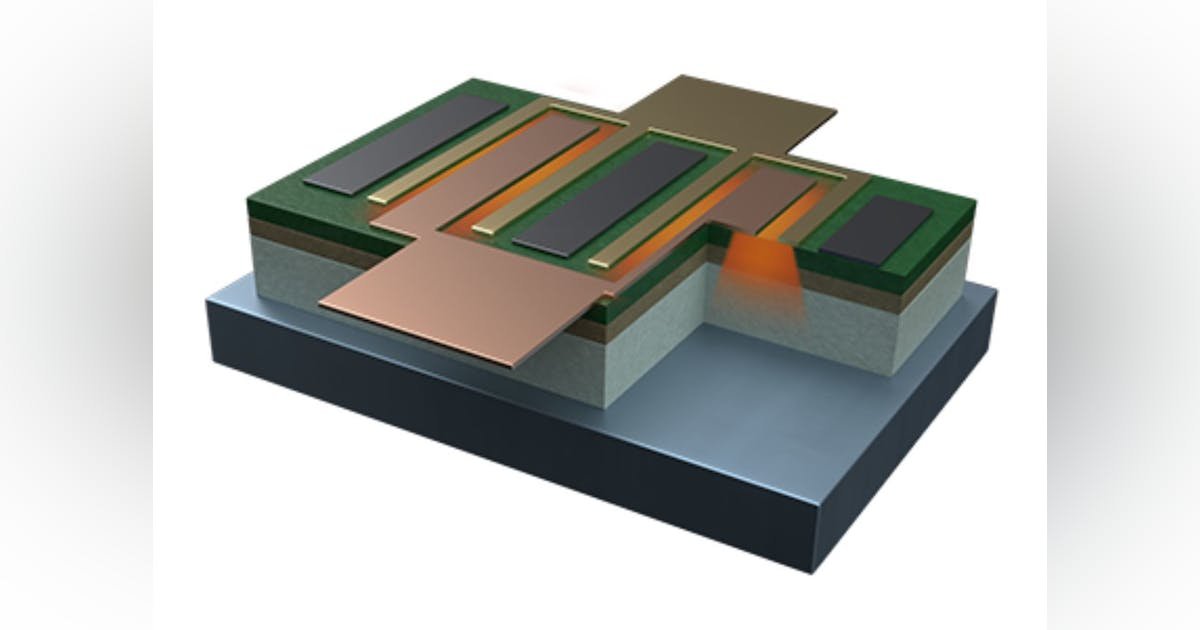
ARLINGTON, Va. – U.S. navy researchers want to two prime U.S. protection contractors to restrict waste warmth in gallium nitride (GaN)-based energy amplifiers that may restrict the efficiency and lifetimes of navy radar, digital warfare (EW), communications, and different RF and microwave programs.
Officers of the U.S. Protection Superior Analysis Tasks Company (DARPA) awarded contracts final month to Raytheon Applied sciences Corp. (RTX) and to Northrop Grumman Corp for the Applied sciences for Warmth Elimination in Electronics on the Gadget Scale (THREADS) program.
THREADS seeks to develop RF and microwave microelectronics applied sciences that may overcome the thermal limitations that may forestall transistors from working reliably at RF output energy density near their elementary digital limits.
Raytheon gained a $14.9 million THREADS contract on 29 Sept. 2023, and Northrop Grumman gained a $14.2 million THREADS contract on 13 Sept. 2023.
Associated: Needed: high-power RF and microwave amplifiers for electronics-killing digital warfare (EW) programs
The efficiency of radar and communication programs will depend on the signal-to-noise ratio achievable on the receiver, which is proportional to the RF output energy of the transmitter. The dimensions of RF apertures in navy programs usually are restricted, so the one approach to enhance vary is by rising the RF output energy of the transmitter energy amplifier.
The RF output energy densities of at the moment’s navy RF transmitters considerably are thermally restricted to beneath their theoretical digital limits. Vast-bandgap transistors like gallium nitride (GaN) had been developed to enhance output energy in energy amplifiers by as a lot as 5 instances in comparison with older gallium arsenide (GaAs) transistor expertise.
But limiting will increase in sustained GaN energy output continues to be extreme waste warmth within the transistor channel layer, which causes elevated channel temperatures and system injury.
Associated: DARPA faucets CPI for amplifiers for high-power microwaves for future functions of electromagnetic warfare
Attaining the transistor output energy close to the GaN elementary digital restrict whereas sustaining a channel temperature beneath the nominal most temperature of 225 levels Celsius requires a major discount within the thermal resistance of the transistor, whereas preserving digital properties of wide-bandgap semiconductors.
Within the THREADS program, Raytheon and Northrop Grumman will concentrate on reaching excessive energy density by lowering transistor thermal resistance in two methods: lowering thermal resistance inside the system whereas sustaining good channel present transport properties; and transferring warmth away from high-power transistors extra effectively with out degrading RF efficiency.
The businesses will exhibit environment friendly X-band transistors and energy amplifiers. an eight-times discount in transistor thermal resistance; and dependable operation with a mean-time-to-failure of 106 hours at 225 C channel temperature.
Associated: Navy avionics consultants select high-power amplifier items from North Star Scientific for E-2D service plane
Raytheon and Northrop Grumman engineers will attempt to scale back thermal resistance inside the system whereas sustaining good channel present transport properties by lowering interfacial and skinny movie thermal resistance inside the system’s epitaxial layer stack. THREADS additionally will develop new methods to unfold waste warmth and scale back transistor thermal resistance to keep up channel temperature of 225 C.
The businesses will incorporate electro-thermal co-design, modeling, and simulation to information system optimization. THREADS is a four-year program.
For extra info contact Raytheon on-line at www.rtx.com/raytheon/what-we-do/advanced-technology/microelectronics, Northrop Grumman at www.northropgrumman.com/what-we-do/microelectronics-space-park, or DARPA at www.darpa.mil.
